Greetings from sunny Arizona! Linda Araya here, project mentor for the composting project at Bergen Community College (BCC), and I am at the Compost 2019 conference hosted by the United States Composting Council whose goal is to create awareness in the benefits of composting for healthier soil, cleaner air and water, and a more stable climate. Many of the attendees at this conference are industrial farmers, business owners, and students and we are all interested in learning more about composting and its glorious benefits.
Here is a summary of Day 1 at the conference (click the links for more information):
Today's workshop was special because it was all about vermicomposting! Dr. Rhonda Sherman from North Carolina State University is an expert at worm farming and held a workshop titled "Boost Profits for Your Composting Operation with Value-Added Products" to teach us all about the benefits of vermicomposting, how it is different from composting, and also shared some tips for those interested in getting started in vermicomposting on a small or large scale. She also wrote a handbook for those looking into getting started and contains 25 years worth of information she has gathered throughout her work as a vermicomposting scientist.
So I learned something new today... vermicomposting is not composting! Vermicompost is not compost. Vermicompost tea is not liquid from the worm bin. Let that sink in for a bit. I knew I was entering territory outside of my expertise although I was able to answer a lot of the questions about the biology of compost (if I can find a link to her presentation, I'll try to link it here somewhere.) At BCC, we utilize an industrial composter called the Rocket composting system. We are a bit spoiled because it removes a lot of the labor we would otherwise have to put in for the amount of effort it actually takes to compost in a traditional manner. However, with vermicomposting it only takes between 40 and 60 days to gain beautiful, rich soil. For those of you who think of soil as "just dirt" know that even though to our eyes it may not look like much it is actually filled with life and lots of chemistry, we just can't see it. With vermicomposting, the stars of the show are the worms Eisenia fetida. Their poop is what everyone is after. Their excrement creates businesses, increases crop yield, and is highly coveted (if you are interested in learning about earthworm husbandry the right way, click HERE). You can do this either on a small scale in your kitchen or on a larger scale and make it into a business. There are many ways you can make it profitable with minimal startup costs. The thing that vermicomposting and traditional composting have in common is the fact that they are both ways to help you reduce your food waste. The ways that you do them are very different, but they each help tackle the food waste issue.
After this amazing talk Mr. Zach Brooks, owner of the Arizona Worm Farm, talked to us about his dream that he built and made it into a reality. He was able to purchase land and begin his business where he sells "worm castings" (aka worm poop), vermicompost tea (NOT for drinking), and worms! (I found this podcast where he talks about his farm HERE). After his talk, we took a drive over to the farm. Here are some pictures from the day.
Monday, January 28, 2019

Friday, January 25, 2019
A Meeting With Culinary Staff
I'm proud to announce that we had a very wonderful meeting with the culinary staff on our campus! Both Professor Zilkha and Professor Wilson not only were on board with our program but were outright excited to join forces with us to support our ongoing efforts to make our campus waste less and be more green! Starting the week of January 28th, we will be collecting food waste from not only the cafeteria as per usual, but also the culinary classes in Pitkin AND in Ender Hall! That's THREE pickups per day of food that would otherwise be put directly in the trash. I know I don't only speak for myself when I say I am so happy and proud of all the people who want to help us and the opportunities we're opening up. We still have a lot to do to, but this is a HUGE milestone in our goal of one day having our whole campus united under our campaign. Go team!
- Mallory E.
- Mallory E.
Wednesday, July 25, 2018
Project Setbacks and Solutions
Unfortunately, we don't have any soil that we can use yet. In fact, it appeared that our Rocket only wanted to spit out woodchips for us. Luckily, we were able to get a man from Food Waste Experts (the sellers of The Rocket) to service our Rocket.
We now know how to properly work the rocket!
First off, a mysterious plug that was chewed up by a groundhog was important to the Rocket... It powers the fan so that the excess gasses can be vented out.
We also found out that we need an equal part of woodchips for the food we put in. Basically a one for one ratio. We got some woodchips, however... They're all wet. So we need to get those all dry...
We also found out a "recipe" to "reset" the rocket. Three times a day, we need to feed the rocket compost, food, and woodchips. After this, the rocket should be ready to take food and woodchips to give us soil.
It appears that the two of us, along with the occasional student, do not make enough food for the Rocket to truly work. The food is basically turning into dust inside the dry machine.
We have plans to fix this though! We're making a call to action: More food, and more often! Every day we need a bunch of food, almost three times what we've been putting in just by ourselves. We need a working woodchipper so we can get ourselves dry woodchips! We need a hose for water access and to clean the drainer, we need a pitchfork and shovel for our piles, and we need a place to cure what the rocket spits out.
It feels as though we've taken one step forward and ten steps back, but I believe we can do it, all together, with the help of lots of people on campus! We need food from everyone, and we need to recruit more people. I believe with hard work, we can really get this going!
We now know how to properly work the rocket!
First off, a mysterious plug that was chewed up by a groundhog was important to the Rocket... It powers the fan so that the excess gasses can be vented out.
We also found out that we need an equal part of woodchips for the food we put in. Basically a one for one ratio. We got some woodchips, however... They're all wet. So we need to get those all dry...
We also found out a "recipe" to "reset" the rocket. Three times a day, we need to feed the rocket compost, food, and woodchips. After this, the rocket should be ready to take food and woodchips to give us soil.
It appears that the two of us, along with the occasional student, do not make enough food for the Rocket to truly work. The food is basically turning into dust inside the dry machine.
We have plans to fix this though! We're making a call to action: More food, and more often! Every day we need a bunch of food, almost three times what we've been putting in just by ourselves. We need a working woodchipper so we can get ourselves dry woodchips! We need a hose for water access and to clean the drainer, we need a pitchfork and shovel for our piles, and we need a place to cure what the rocket spits out.
It feels as though we've taken one step forward and ten steps back, but I believe we can do it, all together, with the help of lots of people on campus! We need food from everyone, and we need to recruit more people. I believe with hard work, we can really get this going!
Wednesday, July 18, 2018
Soil Nutrients
The majority of plants that grow naturally in the East Coast require sixteen essential nutrients, which they need to have in their soil so that they can thrive and grow. We are hoping that our soil will have these nutrients, and if it doesn't, we will try to add them. Luckily, Rutgers offers soil testing, as kits can be quite expensive the more detailed they are.
The four main nutrients:
- Carbon
- Hydrogen
- Oxygen
- Nitrogen
Five Macro Nutrients: (Macro means big, meaning it needs lots of these)
- Phosphorus
- Sulfur
- Calcium
- Potassium
- Magnesium
Seven Micro Nutrients/Trace Elements: (Micro means small, so it only needs a bit of these or just barely any)
- Boron
- Copper
- Iron
- Manganese
- Molybdenum
- Zinc
- Chlorine
Contaminates it should have very low or no amounts of:
- Arsenic
- Lead
- Mercury
- Nickel
- Cadmium
- Copper
- Flourine
- Zinc
- Manganese
- Boron
Monday, July 2, 2018
Waking Up the Vega-Watt
A few years ago, our campus bought a Vega-Watt for the campus. It was supposed to take in used cooking oil and be fueled by it. It doesn't change the oil besides filtering it, it is simply capable of creating power from the oil with its alternated engine.



However, the machine was never used, and thus rotted away surrounded by old leaves and garbage. We had to fix that!
 |
| Here's the open machine |
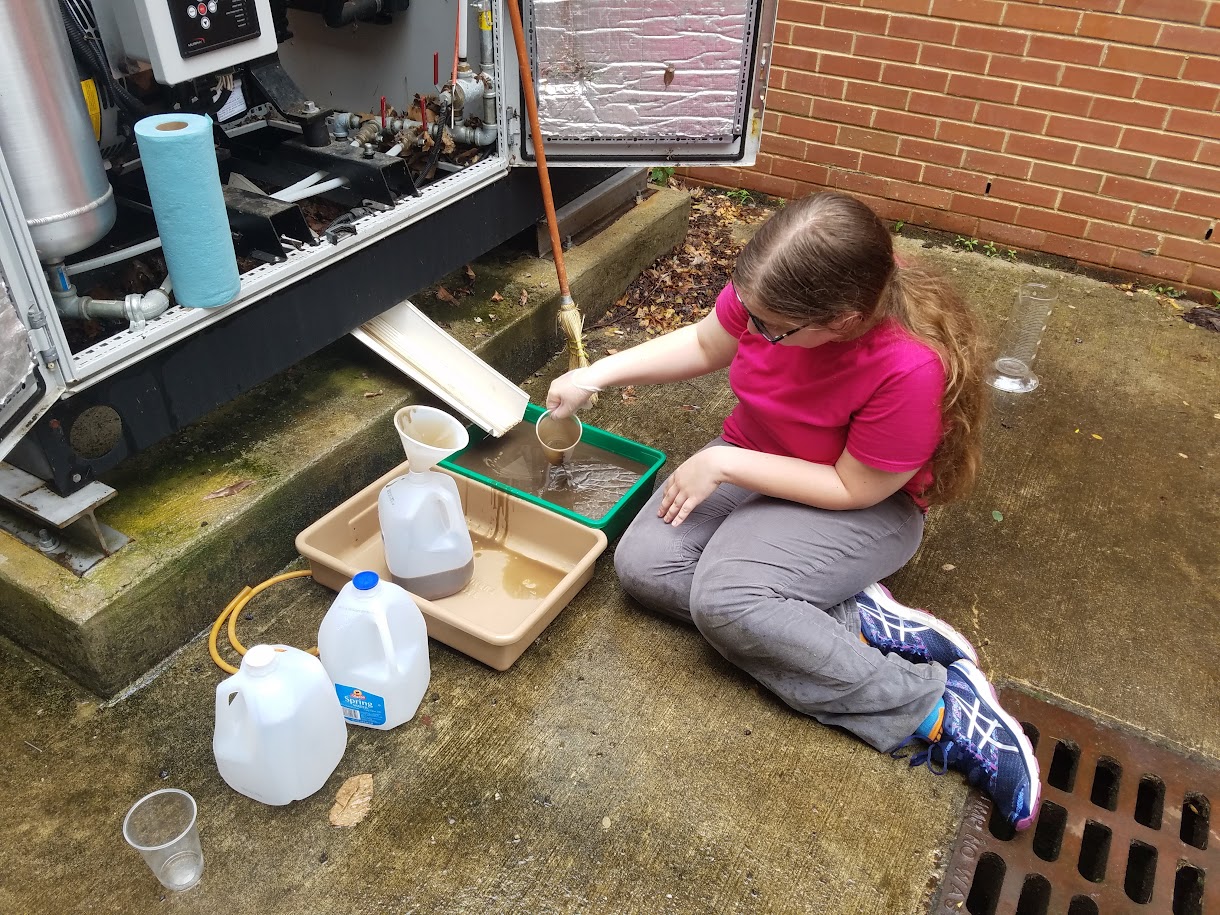
First off, we had to change the oil in the machine. It seems like perhaps it was filled with oil at some point, and it mixed with rainwater and filled up the reservoir in the engine. We figured out a way to drain the oil using a storm gutter and some dish pans. There was a lot, and we didn't want to contaminate the environment, so we had to be very careful.
 |
| Here is Luis undoing the bolt that is holding back all the liquid |
  |
| The oil and water were sitting together for so long the water had a weird color to it. |
 |
| Now we start to see chunks of oil |
  |
| Here comes the oil that was all on the top, as it doesn't mix with water! |
  |
| Almost went over the top, but we had just enough room |
 |
| Gloves for safety, very weird looking. |
After this all was done, we had to safely get the oil and water mixture into a container so it can be properly disposed. with gloves and a plastic cup, I slowly dumped the mixture into three 1-gallon jugs.
Then everything was finally clean! We still have a lot more work to do, but everything looks much better now.
Until next time!
-Mallory
Thursday, June 14, 2018
The Four 'R's
To reduce waste on our planet and prevent the environment from getting worse, there are four R-words that we can follow to help our planet recover from the waste we have caused to pile up throughout the years.
Reduce
Try not to buy disposable items. Think of all the thousands of tea bags, disposable razor blades and styrofoam cups are thrown away every day. Styrofoam is especially bad for the environment. Try to reuse these things, or find a version that is reusable.
Reuse
Try to fix things rather than buy new ones immediately. There are plenty of items that you can reuse instead of throwing away. If a shirt rips sew it, if a button comes off sew it back on. If an electronic breaks fix it or figure out a solution. Not everything has to be thrown away immediately! Rather than tea bags, invest in a tea infuser. Instead of paper cups, use washable glasses.
Recycle
Sometimes you can't reuse or fix something. Try to find a way to recycle it! Old batteries and electronics can be recycled. So can plastic bottles and aluminum cans.
Rot
The 'R' that everyone seems to forget. Instead of throwing away apple cores or banana peels, get a compost bin! Throw the scraps in there, throw all your scraps in! This reduces landfill waste while also creating your own usable soil. Throw in a few worms if you want it to go faster!
If you want to help the environment, remember the four 'R's! But don't feel bad about getting a fancy new computer for yourself when your old one was just fine. Individual consumers don't effect the environment as much as extremely wasteful large corporations. That's capitalism for you.
Monday, June 4, 2018
What Makes Ideal Soil?
So, what makes ideal soil? To answer this, we first have to look at all of the different naturally occurring soil types. Most gardeners group these types into one of five:
- Sandy Soil: Has the largest particles, does not hold onto water well. Nutrients are very easily washed away. However, it becomes warm fast when exposed to the sun. It is also lightweight compared to the other types. It is dry and gritty.
- Silty Soil: This type of soil has smaller particles than sand. This type of soil retains water slightly better than sand. However, it doesn't hold many nutrients, nor is it aerated well. It also tends to be too compact and thus can get too wet for the plant. It is smooth to the touch, and becomes slick when wet.
- Clay Soil: This soil has the smallest particles of all the main types, allowing it to store water and nutrients easily. However, with how compact it gets, it can get hard and heavy once it dries out. It also takes a while to warm up. It feels sticky to the touch when wet, smooth when dry.
- Peaty Soil: This type of soil is very moist and filled with nutritious organic matter. It is very heavily saturated with water and sometimes can need to be drained. It is capable of holding in moisture during hot and dry months while also protecting the roots from over saturation of water during rainy months. It is slightly acidic. Peat can also be a fire hazard if it gets too dry. It is sponge-like to the touch, and may leak water when squeezed.
- Saline Soil: Found in extremely dry regions, this type of soil has a very high salt content. This soil isn't very good for plants as the salt suck up all the water that the roots can use. It usually has a film of white over the top due to the salt.
Which of these soils is the perfect soil?
This soil is called "loam." Loam is made by combining silt, clay, and sand, as well as a bit of humus. It has a high content of organic matter, as well as being slightly acidic and high in calcium. It is capable of holding tightly to water, but is also capable of draining access due to the space between the soil particles. This is the type of soil we are aiming for when it comes to nutrition content, texture, water retainability and particle size. According to AgVerra.com, "The feel test for loam yields a smooth, partly gritty, partly sticky ball that crumbles easily." [Leineriza]
This type of soil is the end goal that we hope to achieve.
This type of soil is the end goal that we hope to achieve.
Now that we know the perfect texture for soil, what about the chemicals inside of it? That will be the topic of our next post.
- Mallory
Subscribe to:
Posts (Atom)